

Emotions play an important part in the negotiation process, although it is only in recent years that their effect is being studied. Emotions have the potential to play either a positive or negative role in negotiation. During emotions can cause intense and even irrational behavior, and can cause conflicts to escalate and negotiations to break down, but may be instrumental in attaining concessions. On the other hand, positive emotions often facilitate reaching an agreement and help to maximize joints gain, but can also be instrumental in attaining concessions. Positive and negative discrete emotions can be strategically displayed to influence task and relational outcomes and may play out differently across cultural boundaries.
情绪在谈判过程中扮演着重要角色,尽管直到最近几年人们才开始研究其影响。情绪在谈判中既可能发挥积极作用,也可能产生消极作用。在谈判过程中,情绪可能引发激烈甚至非理性的行为,导致冲突升级、谈判破裂,但同时也有助于争取让步。另一方面,积极情绪通常有助于达成协议,促进共同收益的最大化,但也同样可能被用来争取让步。积极和消极的具体情绪可以策略性地展现,以影响任务结果和关系结果,并且在不同的文化背景下可能产生不同的效果。
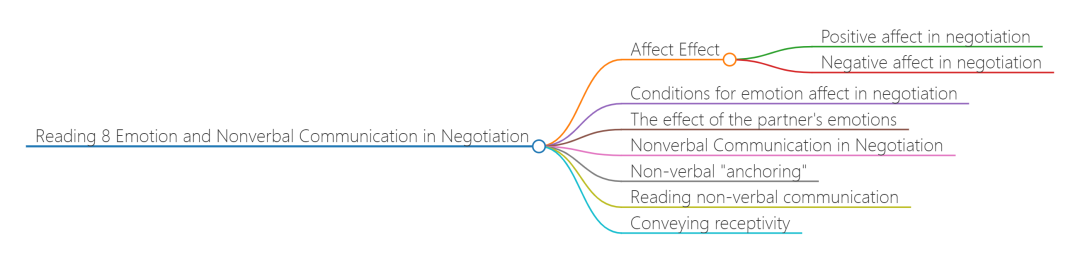
Affect Effect
----情绪之效
Dispositional affects affect the various stages of the negotiation process: which strategies are planned to be used, which strategies are actually chosen, the way the other party and his or her intentions are perceived, their willingness to reach an agreement and the final negotiated outcomes. Positive affectivity and negative affectivity of one or more of the negotiating sides can lead to very different outcomes.
性格情绪会影响谈判过程的各个阶段:例如计划使用哪些策略、实际选择哪些策略、如何看待对方及其意图、对方达成协议的意愿,以及最终的谈判结果。谈判一方或多方的积极情绪特质和消极情绪特质可能会导致截然不同的结果。
Positive affect in negotiation
---谈判中的积极情绪
Even before the negotiation process starts, people in a positive mood have more confidence, and higher tendencies to plan to use a cooperative strategy. During the negotiation, negotiators who are in a positive mood tend to enjoy the interaction more, show less contentious behavior, use less aggressive tactics and more cooperative strategies. This in turn increases the likelihood that parties will reach their instrumental goals, and enhance the ability to find integrative gains.
Indeed, compared with negotiations with negative or natural affectivity, negotiators with positive affectivity reached more agreements and tended to honor those agreements more. Those favorable outcomes are due to better decision making processes, such as flexible thinking, creative problem solving, respect for others' perspectives, willingness to take risks and higher confidence. Post negotiation positive affect has beneficial consequences as well. It increases satisfaction with achieved outcome and influences one's desire for future interactions. The PA aroused by reaching an agreement facilitates the dyadic relationship, which result in affective commitment that sets the stage for subsequent interactions. PA also its drawbacks: it distorts perception of self-performance,such that performance is judged to be relative better than it actually is. Thus, studies involving self-reports on achieved outcomes might be biased.
即使在谈判过程开始之前,情绪积极的人也更有信心,更倾向于计划使用合作策略。在谈判过程中,情绪积极的谈判者往往更享受互动,表现出较少的争论行为,使用更少的攻击性策略和更多的合作策略。这反过来增加了各方实现其工具性目标的可能性,并增强了寻找整合收益的能力。
事实上,与消极或自然情绪的谈判相比,情绪积极的谈判者达成的协议更多,并且倾向于遵守这些协议。这些有利的结果归因于更好的决策过程,比如灵活的思维、创造性的问题解决、尊重他人的观点、愿意承担风险以及更高的自信心。谈判后的积极情绪也会带来有益的后果。它能提高对已达成结果的满意度,并影响个体对未来互动的意愿。达成协议所激发的积极情绪有助于促进双方关系,从而产生情感承诺,为后续互动奠定基础。然而,积极情绪也有其缺陷:它会扭曲对自我表现的认知,使人认为自己的表现比实际情况更好。因此,涉及自我报告达成结果的研究可能会存在偏差。
Negative affect in negotiation
---谈判中的消极情绪
Negative affect has detrimental effects on various stages in the negotiation process. Although various negative emotions affect negotiation outcomes, by far the most researched is anger. Anger negotiation plan to use more competitive strategies and to cooperate less, even before the negotiation starts. These competitive strategies are related to reduced joint outcomes. During negotiations, anger disrupts the process by reducing the level of trust, clouding parties' judgment to retaliating against the other side. Angry negotiator pay less attention to opponent's interests and are less accurate in judging their interests, thus achieve lower joint gains. Moreover, because anger makes negotiators more self-centered in their preference, it increase the likelihood that they will reject profitable offers.
Opponents who really get angry(or cry, or otherwise lose control) are more likely to make errors: make sure they are in your favor. Anger dose not help in achieving negotiation goals either: it reduces joint gains and does not help to boost personal gains, as angry negotiators do not succeed in claiming more for themselves. Moreover, negative emotions lead to acceptance of settlement that are not in the positive utility function but rather have a negative utility. However, expression of negative emotions during negotiation can sometimes be beneficial: legitimately expressed anger can be an effective way to show one's commitment, sincerity, and needs . Moreover, although NA reduces gains in negative way to show one's commitment, sincerity, and needs. Moreover, although NA reduces gains in integrative tasks, it is a better strategy than PA in distributive tasks (such as zero-sum).
In his work on negative affect arousal and white noise, Seidner(1991) found support for the existence of a negative affective arousal mechanism through observations regarding the devaluation of speakers from other ethnic origins. Negotiation may be negatively affected, in turn, by submerged hostility toward an ethnic or gender group.
负面情绪对谈判过程的各个阶段都有不利影响。虽然各种负面情绪都会影响谈判结果,但迄今为止研究最多的是愤怒。愤怒会让谈判者倾向于使用更具竞争性的策略,并减少合作,即使在谈判开始之前也是如此。这些竞争性策略与降低的共同结果相关。在谈判过程中,愤怒通过降低信任水平、模糊各方的判断从而报复对方而扰乱谈判过程。愤怒的谈判者对对方的利益关注较少,而且在判断对方利益时准确性较低,因此实现共同收益较低。此外,由于愤怒使得谈判者在偏好上更加以自我为中心,这增加了他们拒绝有利报价的可能性。与此同时,对某个种族或性别群体潜在敌意也会对谈判产生负面影响。
真正生气(或者哭泣,或者以其他方式失去控制)的对手更容易犯错;确保这些错误对你有利。愤怒也无助于实现谈判目标:它会减少共同利益,并且无法帮助个人获得更多利益,因为愤怒的谈判者往往无法为自己争取更多。此外,负面情绪会导致接受那些对自己没有正面效用、反而有负面效用的和解方案。然而,在谈判中表达负面情绪有时也可能是有益的;合理表达愤怒可以有效地展示一个人的承诺、诚意和需求。此外,虽然负面情绪在整体利益性任务中会减少收益,但在分配性任务(如零和任务)中,它是一种比积极情绪更好的策略。
在他关于消极情绪唤起和白噪音的研究中,Seidner(1991)通过观察对来自其他族裔的发言者的贬值,发现了消极情绪唤起机制的存在。这可能会反过来对谈判产生负面影响,因为对某个族裔或性别群体存在潜在的敌意。
Conditions for emotion affect in negotiation
---谈判中情绪影响的条件
Research indicates that negotiator's emotions do not necessarily affect the negotiation process. Albarralin et al.(2003) suggested that there are two conditions for emotional affect, both related to the ability (presence of environmental or cognitive disturbances) that the motivation:
• Identification of the affect: requires high motivation, high ability or both. • Determination that the affect is relevant and important for the judgment: requires that either the motivation, the ability or both are low.
研究表明,谈判者的情绪不一定会影响谈判过程。Albarralin等人指出,情绪影响存在两个条件,两者都与能力(环境或认知干扰的存在)和动机有关:
• 情绪识别:需要高动机、高能力或两者兼备 • 确定情绪对判断的相关性和重要性:要求动机、能力或两者中任意一项较低
According to this model, emotions are expected to affect negotiations only when one is high and the other is low. When both ability and motivation are low the affect will not be identified, and when both are high the affect will be identify but discounted as irrelevant for judgment. A possible implication of this model is, for example , that the positive effects PA has on negotiations(as described above) will be seen only when either motivation or ability are low.
根据这一模型,情绪预计只会在一方高另一方低时影响谈判。当能力和动机都低时,情绪不会被识别;当两者都高时,情绪会被识别,但会被视为与判断无关而被忽略。该模型的一个可能含义是,例如,积极情绪(PA)对谈判的积极影响(如上所述)只有在动机或能力中任意一方较低时才会显现。
The effect of the partner's emotions
---合伙人情绪的影响
Most studies on emotion in negotiations focus on the effect of the negotiator's own emotions on the process. However, what the other party feels might be just as important, as group emotions are known to affect processes both at the group and the personal levels. When it comes to negotiations, trust in the other party is a necessary condition for its emotion to affect, and visibility enhances the effect. Emotions contribute to negotiation precesses by signaling what one feels and thinks and can thus prevent the other party from engaging in destructive behavior and to indicate what steps should be taken next: PA signals to keep in the same way, while NA points that mental or behavioral adjustments are needed.
大多数关于谈判中情绪的研究都集中在谈判者自身情绪对谈判过程的影响上。然而,对方的情绪可能同样重要,因为群体情绪已知会影响群体和个人两个层面的过程。在谈判中,对对方的信任是其情绪能够产生影响的必要条件,而可见性则会增强这种影响。情绪通过传达个人的感受和想法,为谈判过程中做出贡献,从而可以防止对方采取破坏性行为,并表明接下来应采取的步骤:积极情绪(PA)信号表示保持现状,而消极情绪(NA)则表明需要进行心理或行为上的调整。
Partner's emotions can have two basic effects on negotiator's emotions and behavior: mimetic/reciprocal or complementary. For example, disappointment or sadness might lead to compassion and more cooperation. In a study by Butt et al. (2005) which simulated real multi-phase negotiation, most people reacted to the partner's emotions in reciprocal , rather than complementary, manner. Specific emotions were found to have different effects on the opponent's feelings and strategies chosen:
• Anger caused the opponents to place lower demands and to concede more in a zero-sum negotiation, but also to evaluate the negotiation less favorably. It provoked both dominating and yielding behaviors of the opponent. • Pride led to more integrative and compromise strategies by the partner. • Guilt or regret expressed by the negotiator led to better impression of him by the opponent, however it also led the opponent to place higher demands. On the other hand, personal guilt was related to more satisfaction with what one achieved. • Worry or disappointment left bad impression on the opponent, but led to relatively lower demands by the opponent.
合作方的情绪对谈判者的情绪和行为可以产生两种基本影响:模仿/互惠或互补。例如,失望或悲伤可能引起同情并增加合作。在 Butt 等人(2005)的研究中,该研究模拟了真实的多阶段谈判,大多数人对合作方的情绪反应是互惠的,而不是互补的。研究发现,不同的情绪对对方的感受和选择的策略有不同影响:
• 愤怒会导致对手在零和谈判中提出较低的要求并做出更多让步,但也会使其对谈判的评价较低。它引发了对手既主导又让步的行为 • 自豪感会使合作方采取更多整合性策略和妥协策略 • 谈判者表达的内疚或悔恨会让对手对其印象更好,但也会导致对手提出更高的要求。另一方面,个人内疚与更高的满意度相关 • 担忧或失望给对手留下了不良印象,但反而导致对手提出了相对较低的要求。
Nonverbal Communication in Negotiation
---谈判中的非语言交流
Communication is a key element of negotiation. Effective negotiation requires that participants effectively convey and interpret information. Participants in a negotiation will communicate information not only verbally but non-verbally through body language and gestures. By understanding how nonverbal communication works, a negotiator is better equipped to interpret the information other participants are leaking non-verbally while keeping secret those things that would inhibit his/her ability to negotiate.
沟通是谈判的关键要素。有效的谈判要求参与者能够有效地传达和解读信息。谈判参与者不仅通过语言,还通过身体语言和手势进行非语言的沟通。通过理解非语言沟通的运作方式,谈判者能够更好地解读其他参与者非语言泄露的信息,同时保守那些可能妨碍其谈判能力的秘密。
Non-verbal "anchoring"
非语言“锚定”
In a negotiation, a person can gain the advantage by verbally expressing his/her position first. By "anchoring" your position, you establish the position from which the negotiation will proceed. In a like manner, one can "anchor" and gain advantage with nonverbal (body language) ques.
• Personal space: The person at the head of the table is the apparent symbol of power. Negotiators can repel this strategic advantage by positioning allies in the room to surround that individual. • First impression: Begin the negotiation with positive gestures and enthusiasm. Look the person in the eye with sincerity. If you cannot maintain eye contact, the other person might think you are hiding something or that you are insincere. Give a solid handshake.
在谈判中,一个人通过先口头表达自己的立场可以获得优势。通过“锚定”自己的立场,你确定了谈判将从何立场开始。同样地,人们也可以通过非语言(肢体语言)提示来“锚定”并获得优势。
• 个人空间:桌子首位的人显然是权力的象征。谈判者可以通过在房间中安排盟友包围该个人来抵消这一战略优势。 • 第一印象:以积极的姿态和热情开始谈判。真诚地与对方进行眼神交流。如果你无法保持眼神接触,对方可能会认为你在隐瞒什么或者不够真诚。握手要有力。
Reading non-verbal communication
---解读非语言沟通
Being able to the non-verbal communication of another person can signification aid in the communication process. By being aware of inconsistencies between a person's verbal and non-verbal communication and reconciling them, negotiators will be able to come to better resolutions. Examples of incongruity in body language include:
• Nervous laugh: A laugh not matching the situation. This could be a sign of nervousness or discomfort. When this happens, it may be good to probe with questions to discover the people's true feelings. • Positive words but negative body language: if someone asks their negotiation partner if they are annoyed and the person pounds their fist and responds sharply, "what makes you think anything is bothering me?" • Hands raised in a clenched position: The person raising his/her hands in this position reveals frustration even when he/she is smilling. This is a signal that the person doing it may be holding back a negative attitude. • If possible, it may be helpful for negotiation partners to spend time together in a comfortable setting outside of the negotiation room. Knowing how each partner non-verbally communicates outside of the negotiation setting will help negotiation partners to sense incongruity between verbal and non-verbal communication within the negotiation setting.
能够理解他人的非语言交流可以显著帮助沟通过程。通过注意一个人的言语和非语言交流之间的不一致加以调和,谈判者将能够达成更好的解决方案。肢体语言不一致的例子包括:
• 紧张的笑声:与情境不符的笑声。这可能是紧张或者不舒服的表现。当出现这种情况时,可以通过提问来探查对方真实感受 • 积极的言辞但消极的肢体语言:如果有人问谈判对方是否恼怒,而对方握紧拳头并尖锐地回答,“你凭什么认为我在生气?” • 举起的紧握双手:即使微笑时举起双手,也表达了挫败感。这表明做出这种动作的人可能在压抑负面情绪。 • 如果可能,让谈判双方在谈判室外的舒适环境中共度时光可能会有所帮助。了解每位谈判伙伴环境外的非语言交流方式,有助于谈判双方在谈判过程中感知语言和非语言交流之间的不一致之处。
Conveying receptivity
---表达接受度
The way negotiation partners position their bodies relative to each other may influence how receptive each is to the other person's message and ideas.
• Face and eyes: Receptive negotiators smile, make plenty of eye contact. This conveys the idea that there is more interest in the person than in what is being said. On the other hand, non-receptive negotiators make little to no eye contact. Their eyes may be squinted, jaw muscles clenched and head turned slightly away from the speaker. • Arms and hands: To show receptivity, negotiatiors should spread arms and open hands on table or relaxed on their lap. Negotiators show poor receptivity when their hand are clenched, crossed, positioned in front of their mouth, or rubbing the back of their neck. • Leg and feet: Receptive negotiators sit with legs together or one leg slightly in front of the other. When standing, they distribute weight evenly and place hands on their hips with body tilted toward the speaker. Non-receptive negotiators stand with legs crossed, pointing away from the speaker. • Torso: Receptive negotiators sit on the edge of their chair, unbutton their suit coat with their body tilted toward the speaker. Non-receptive negotiators may lean back in their chair and keep their suit coat buttoned. Receptive negotiators tend to appear relaxed with their hands open and palms visibly displayed.
谈判伙伴之间身体位置的相互方式可能会影响双方对对方信息和想法的接受程度
• 面部和眼睛:有接受意愿的谈判者会微笑,并进行大量眼神交流。这传达出对人本身的兴趣多于所说内容的意思。另一方面,不容易接受的谈判者很少或几乎不进行眼神交流。他们的眼睛可能微眯,下巴肌肉紧绷,头略微偏离说话者。 • 手臂和手:为了显示接受意愿,谈判者应伸开手臂,双手摊开放在桌上或轻松地放在膝上。手握紧、交叉、放在嘴前或揉脖子背部的谈判者则显示出低接受度。
• 腿和脚:容易接受的谈判者坐姿双腿并拢或一条腿略在前。当站立时,他们体重均匀分布,双手叉腰,身体略向说话者倾斜。难以接受的谈判者站立时双腿交叉,脚尖远离说话者。 • 躯干:难以接受的谈判者坐在椅子边缘,解开西装外套扣子,身体向说话者倾斜。难以接受的谈判者可能会在椅子上向后靠,并保持西装外套扣上。容易接受的谈判者通常看起来放松,双手摊开,掌心可见。