

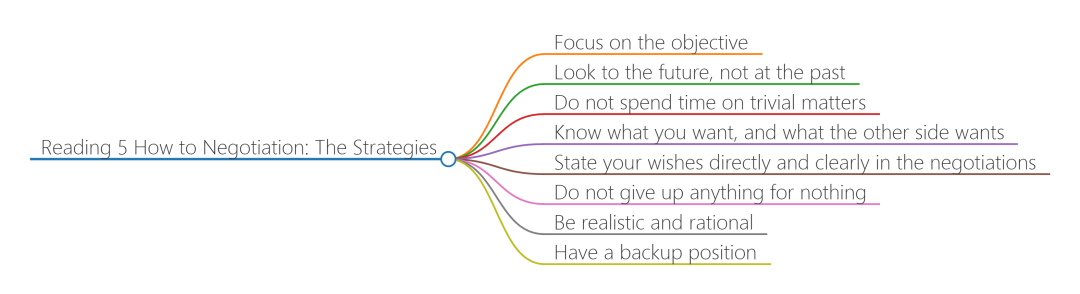
Once the framework is set, you must be clear on your strategies. While you will often change your tactics, depending on how things evolve, you should stick to your strategies.
一旦框架建立,你就必须清楚自己的策略。虽然你会根据情况的发展经常调整战术,但你应该坚持自己的策略。
Focus on the objective
This is the first rule and principle. You must avoid emotions such as anger while you are in the negotiating group. The other side would like to provoke you to anger, to make you lose control. Remember the objective you want to achieve, and do not lose sight of it. Never let yourself be diverted from it. It does not matter if you do not like the other party---you have to respect them. You are not negotiating with your friend; you are negotiating your adversary.
这是第一个规则和原则。在谈判小组中,你必须避免情绪,例如愤怒。对方可能会试图激怒你,让你失去控制。记住你想要实现的目标,不要失去对它的关注。绝不要让自己偏离目标。即使你不喜欢对方,也必须尊重他们。你不是在与朋友谈判,而是在与对手谈判。
Look to the future, not at the past
We often look at the past. But the past is only good for reference. It is what you want to establish in the future that is important. You have identified a problem with your adversary, and when you have identified it , you ask them: What is your goal? What do you want to achieve? Be bold in asking the other party what they want to resolve in the dispute you both have identified. In most cases, where the conflict is complex, you need a mediator or a facilitator, simply as a referee.
我们经常回顾过去。但过去只是参考而已。重要的是你希望在未来建立什么。你已经发现了对方的问题,当你识别出来之后,你可以问他们:你的目标是什么?你想要实现什么?在问对方希望解决你们共同发现的争议时,要大胆。在大多数情况下,当冲突比较复杂时,你需要一个调解人或协调人,仅仅是作为裁判的角色。
Do not spend time on trivial matters
---不用在琐事上浪费时间
In order to avoid the trap of trivial, you should always check where you are. On a scale from 1 to 10, check the priority of the issue you are negotiating. You should always be above the halfway mark on this scale. If you are coming near the middle, check your priorities. If the negotiations produce answers to them, close the deal. Negotiations can be simple, complex, or even very complicated, so do not waste time on trivial matter is determining who will gain which appointment tin the future, as you are not in the future yet. Do not negotiate an agreement with personal interests in mind. These matters are trivial. Establish institutions but one should not focus on personal positions in the institutions that are to be set up.
为了避免陷入琐事的陷阱,你应该时刻检查自己的位置。在从1到10的尺度上,检查你正在谈判的问题的优先级。你应该始终高于此尺度的中点。如果你接近中点,请检查你的优先事项。如果谈判能解决这些问题,就达成交易。谈判可以是简单的、复杂的,甚至非常复杂,所以不要在琐事上浪费时间,比如决定谁将获得未来的某个职位,因为你还未到未来。不要带着个人利益进行谈判,这些都是琐碎的事情。建立机构是必要的,但不应关注将要成立的机构中的个人职位。
Know what you want, and what the other side wants
知道你想要的以及对方想要的
From the onset, make sure you know what you want. If you proceed only based on assumptions as to what you want, you may negotiate for the wrong reason, and the wrong cause. Have a detailed plan of what you want. Also ask the other party to clarify its wishes. Provide a plan, and ask the other side for a plan in response. Negotiations are likely to break down, stall, or end in deadlock if issues of fundamental concern to the other side are left out. If your own fundamental issues are left out, stall the negotiations, call for a break. Sometimes your opponents will want an explanation of why you want something so much. They have a right to ask, and you can explain this to them. But you should also ask why they are so intent on their own priorities.
从一开始,就要确保你清楚自己想要什么。如果你仅仅基于对自己的意愿的假设去行动,你可能会为错误的原因或目的进行谈判。要对自己的需求有一个详细的计划。同时,也要请对方澄清他们的需求。提供一个需求计划,并要求对方提出一个回应计划。如果对另一方根本性关注的问题置之不理,谈判可能会破裂、停滞或陷入僵局。如果忽略了你自身的核心问题,应暂停谈判,要求体会。有时,你的对手可能想要了解你为何如此迫切地想要某件事。他们有权这样询问,你也可以向他们解释。但你也应当询问,他们为何如此坚持自己优先考虑的事项。
State your wishes directly and clearly in the negotiations
You must clearly articulate what you want, otherwise your statement will not be of use to the other party, or the mediator will not be able to help you get what you want. If you do not say what you want, you cannot get it. No one will give you anything unless you express a desire to have it. Sometimes you must give reasons for why you want it. Clarity is important in the presentation of your position. Avoid being distracted by ridiculous offers. Know what you want and go for it. If you explain it explain it clearly, the other side will respect your clarity. If the issues are complex, put them down in writing, so that trade-offs can start early on in the negotiations. Note here a difference between strategies, where it is important to be clear on one's overall goals, and tactics, where it is often wise not to be clear about what one wants.
你必须清楚的表达你想要什么,否则你的陈述对对方没有用,调解员也无法帮助你获得你想要的。如果你不说出你想要什么,你就无法得到它,除非你表达了想要的愿望,否则不会有人给你任何东西。有时你必须说明你想要的原因。在阐述你的立场时,清晰是很重要的。避免被荒谬的提议分散注意力。明确自己想要什么,并为之争取。如果你解释,就要解释清楚,另一方会尊重你的清晰。如果问题复杂,把他们写下来,这样在谈判初期就可以开始权衡取舍,这里指出策略和战术的区别:在策略上,清楚自己的总体目标很重要,而在战术上,通常明智的是不要明确自己想要什么。
Do not give up anything for nothing
At the beginning of a negotiation, do not give away things. If you do so, you will create the wrong impression that you are a pushover. You must have chips for bargaining. These are very important as trade-offs at a later stage when you are about to close a deal. Be the devil's advocate from time to time: Put yourself in the shoes of the other side. Always request for more, and be prepared to give something for it . When it comes to the close , you may have to squeeze more from the other side. But you must be prepared to concede things that you are prepared to live without. Dot not drive the other party to the wall. They may conclude that you not want an agreement after all.
在谈判开始时,不要轻易让步。如果你这样做,会给别人留下你很容易被说服的错误印象。你必须拥有用来谈判的筹码。这些筹码在谈判后期临近达成协议时非常重要,可以用于交换。偶尔要扮演“魔鬼代言人”的角色:换位思考,站在对方的立场上。总是提出更多的要求,并准备为此做出一些让步。在谈判临近结束时,你可能需要从对方那里争取更多。但你必须准备好放弃哪些你可以承受失去的东西。不要把对方逼到绝境,否则他们可能会认为你根本不想达成协议。
Be realistic and rational
要现实和理性
Be reasonable in your demands; otherwise, you will not be taken seriously. If you ask for less, then you may end up even getting less than less. The parties have to be realistic if the dispute is to be resolved. In most cases, parties go to negotiations with idealistic positions and wishes. You should not make unrealistic and outrageous demands. Sometimes, parties start with highly exaggerated demands. They adopt this position so that they can achieve a trade-off at a later stage of the negotiations. When you are confronted with such a strategy, just laugh it off. Do not get angry about it .
在你提出要求时,要讲合理,否则别人不会重视你。如果你要求过少,最终可能得到的甚至比少还少。如果要解决争端,各方必须现实。在大多数情况下,各方带着理想化的立场和愿望进入谈判。你不应提出不切实际或离谱的要求。有时,各方会从高度夸大的要求开始。他们采取这种立场,是为了在谈判的后期实现某种妥协。当你遇到这种策略时,只需一笑置之,不要为此生气。
Have a backup position
It is important to have a backup position. This is not really a fall-back position, but more along the lines of a "Plan B". Do not start a negotiation with your back against the wall. Leave room for maneuver. Propose alternatives to unlock the talks if they reach a stalemate. Think very fast.
拥有备用方案非常重要。这并不真正是退而求其次的方案,而更像是“B计划”。不要被逼到绝境时开始谈判。留有回旋的余地。如果谈判陷入僵局,提出替代方案以推动进程。思考要非常块。