



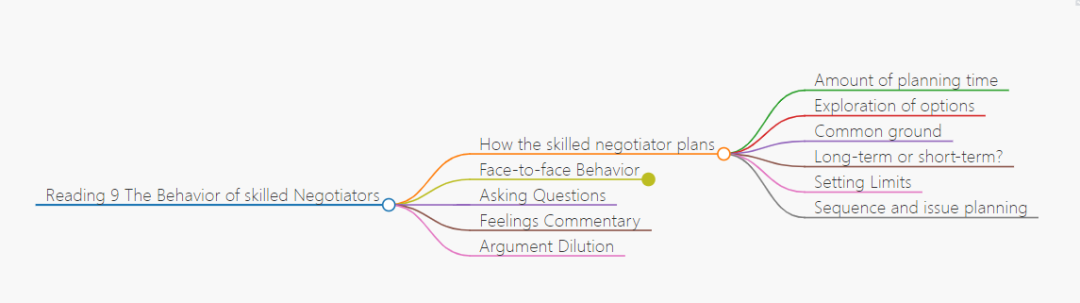
How the skilled negotiator plans
熟练的谈判者如何进行计划?
Negotiation emphasizes the importance of planning. How does the skilled negotiator plan?
谈判强调计划的重要性。数量的谈判者是如何进行计划的?
Amount of planning time
计划时间的长度
There is no significant difference between the total planning time which skilled and average negotiators spend prior to actual negotiation. It suggests that it is not the amount of planning time which makes for success, but how that time is used.
在实际谈判前,熟练的谈判者和普通谈判者所花费的总计划时间没有显著差异。这表明,成功的关键不在于计划时间的长短,而在于如何利用这些时间。
Exploration of options
选项的探索
The skilled negotiator considers a wider range of outcomes or options for action than the average negotiator.
Skilled negotiators are concerned with the whole spectrum of possibilities, both those which they could introduce themselves and those which might be introduced by the people they negotiate with. In contrast, the average negotiator considers few options. They are especially less likely to consider options which might be raised by the other party.
熟练的谈判者会考虑的结果范围或行动选择比普通谈判者更广。
熟练的谈判者关注所有可能性,包括他们自己可能提出的,以及谈判对方可能提出的。相比之下,普通谈判者考虑的选择很少。他们尤其不太可能考虑对方可能提出的选项。
Common ground
共同点
Does the skilled negotiator concentrate during planning on the areas which hold most potential for conflict, or instead give attention to possible areas of common ground? Although both skilled and average negotiators tend to concentrate on the conflict areas, skilled negotiators tend to give over three times as much attention to common ground areas as do average negotiators.
It can be interpreted in variety of ways. It may be, for example, that the skilled negotiator has already built a climate of agreement so that undue concentration on conflict is unnecessary. Equally, concentration on the common ground areas may be the key to building a satisfactory climate in the first place.
A relatively high concentration on common ground areas is known to be an effective strategy of persuasion, notably with "pull" styles of persuasion and in selling situations.
In any event, potential negotiators wishing to model themselves on successful performers would do well to pay special attention to areas of anticipated common ground and not just to areas of conflict.
熟练的谈判者在规划时是集中精力在最可能引发冲突的领域,还是关注可能的共同点领域?虽然熟练和普通谈判者都倾向于集中在冲突领域,但熟练的谈判者在共同点领域的关注度通常是普通谈判者的三倍多。
这可能有多种解读。例如,可能是熟练的谈判者已经营造了一个达成共识的氛围,因此无需过多关注冲突。此外,集中在共同点领域的也可能是首先建立令人满意的氛围的关键。
较高程度地关注共同点领域已经被证明是一种有效的说服策略,尤其是在“拉引式”说服风格和销售情境中。
无论如何,希望以成功谈判者为榜样的潜在谈判者最好特别关注预期的共同利益领域,而不仅仅是冲突领域。
Long-term or short-term?
长期还是短期?
It is often suggested that skilled negotiators spend much of their planning time considering the long-term implications of the issues, which unskilled negotiators concentrate on the short-term. Is this true in practice? Researchers found that both skilled and average negotiators show an alarming concentration on the short-term aspect of issues. With average negotiators, approximately one comment in 25 during their planning is of a long-term consideration, namely a comment which involves any factor extending beyond the immediate implementation of the issue under negotiation. The skilled negotiator, while showing twice as many long-term comments, still only average 8.5 percent of total planning comments. Even so, they demonstrate how little planning time is given by most negotiators to the long-term implications of what they negotiate.
人们常常建议,熟练的谈判者在计划时会花很多时间考虑问题的长期影响,而不熟练的谈判者则更专注于短期。实践中真的如此吗?研究人员发现,无论是熟练还是普通的谈判者,都令人惊讶地集中在问题的短期方面。对于普通谈判者来说,在他们的计划过程中,大约每25条评论中只有一条是关于长期考虑的(即涉及谈判问题的即时实施之外的任何因素的表述)。熟练的谈判者虽然提出的长期表述数量是普通谈判者的两倍,但仍只占总计划表述的平均8.5倍。尽管如此,这仍然显示出大多数谈判者在谈判中的长期影响上投入的计划时间是多么有限。
Setting Limits
设定限制
Skilled negotiators were significantly more likely to set upper and lower limits--to plan in terms of a defined range(e.g.,"we hope to get 37,but we would settle for a minimum of 34"). Average negotiators, in contrast, were more likely to plan their objectives around a fixed point(e.g.,"we aim to settle at 83"). Although one possible explanation is that skilled negotiators have more freedom, which gives them the discretion of upper and lower limits. Even where the average negotiators have considerable capacity to vary the terms of an agreement, they usually approach the negotiation with a fixed-point objective in mind. The conclusion, for would-be negotiators, is that it is preferable to approach a negotiation with objectives specifying a clearly defined range, rather than to base planning on an inflexible single-point objective.
熟练的谈判者更有可能设定上下限----以明确范围进行计划(例如,我们希望得到37,但最低可以接受34)。相比之后,普通谈判者更可能围绕一个固定点来制定目标(例如,我们的目标是达成83)。一种可能的解释是,熟练的谈判者拥有更多的自由度,因此可以自主设定上下限。即使普通谈判者在协议条款上有相当大的变通空间,他们通常也会以固定点目标来进行谈判。对潜在谈判者的结论:是带着明确界定区间的目标去参与谈判,要远好于将规划建立在僵化单一的目标之上。
Sequence and issue planning
顺序与议题规划
The term "planning" frequently refers to a process of sequencing--putting a number of events, points, or potential occurrences into a time sequence. This concept of planning, called sequence planning, works efficiently with inanimate objects, or in circumstances where the planner has real control over the sequence in which events will occur. Average negotiators place very heavy reliance on sequence planning. So, for example, they would frequently verbalize a potential negotiation in terms like, "First I'll cover C and finally go no to D". In order to succeed, sequence planning always requires the consent and cooperation of the other negotiating party. In many negotiations, this cooperation was not forthcoming. The negotiators in difficulty, requiring them to either mentally change gears and approach the negotiation in a sequence they had not planned for, or to carry through the original sequence risking disinterest from the other party. In many negotiations, sequences are, in themselves, negotiable and it is ill-advised for the negotiator to plan on a sequence basis.
规划一词通常指一个排序过程---将若干事件、要点或潜在发生的情况按照事件顺序排序。这个所谓的顺序规划概念,在处理无生命的物体或者在规划者对事件发生的顺序有实际控制的情况下,运行得非常高效。一般谈判者非常依赖顺序规划。例如,他们经常会用类似“首先我会先处理C,最后我再处理D”这样的语言来描述潜在的谈判。为了取得成功,顺序规划总是需要谈判对手的同意和配合。然而在许多谈判中,这种配合并未到位。陷入困境的谈判者必须要么在心理上转换策略,以一种原本未计划的顺序进行谈判,要么坚持原有顺序,但冒着对方失去兴趣的风险。在许多谈判中,顺序本身也是可以协商的,因此谈判者仅以固定的顺序为基础进行计划并不明智。
But sequence planning is the most common way in which people plan and, if it doesn't work with many negotiations, then how should a negotiator plan? Skilled negotiator tends to plan around each individual issue in a way which is independent of any sequence. They would consider issue C, for example, as if issues A, B, and D didn't exist. Compared with the average negotiators, they are careful not to draw sequence links between a series of issues.
但顺序计划是人们最常用的计划方式,如果它在许多谈判中不起作用,那么谈判者应该如何计划呢?熟练的谈判者倾向于围绕每个具体问题进行计划,而不依赖任何顺序。例如,他们会考虑问题C,就好像问题A B D不存在一样。与普通谈判者相比,他们会小心避免在一系列问题之间形成顺序联系。
The clear advantage of issue planning over sequence planning is flexibility. In planning a negotiation, it is important to remember that the sequence of issues itself(unless a pre-set agenda is agreed upon) many be subject to negotiation. Even where an agenda exists, within a particular item, sequence planning may involve some loss of flexibility. So it seems useful for negotiators to plan their face-to-face strategy using issue planning and avoiding sequence planning.
议题规划相对于顺序规划的明显优势是灵活性。在规划谈判时,重要的是要记住议题的顺序本身(除非双方事先同意了议程)可能是协商的。即使存在议程,在特定的议题中,采用顺序规划也可能会损失一定的灵活性。因此,对于谈判者来说,使用议题规划而避免顺序规划来制定面对面的策略显然是大有裨益的。